The Studio Work Behind Famous Live Albums
When Is a Live Album Still Live?
The crowd roars, the singer counts in and a band hits the opening chord. A live album appears to document one night. Yet those cheers may come from another song, the vocal may have been repaired and the running order may combine several venues.
That does not automatically make the record dishonest. Concert recording always involves selection. The question is how much reconstruction it can absorb before documenting a performance becomes manufacturing an ideal one.
The Concert Is Only the Raw Material
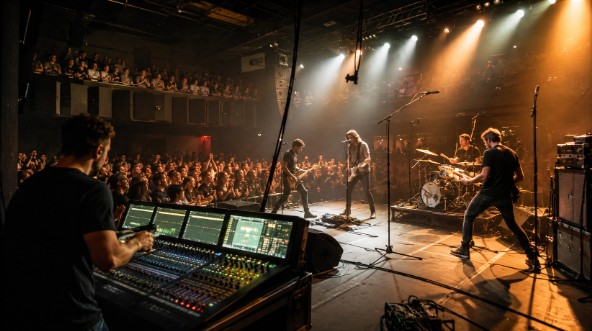
A studio recording is built for microphones; a concert is built for the room. Amplifiers spill into vocal mics, audiences mask quiet details and musicians cannot repeat one damaged phrase without repeating the song.
Recorded entertainment frequently separates what happened from how it sounds. Information at https://australianonlinecasinoguide.com/ may lead to online pokies whose audio is assembled by an event-driven sound engine. Once a wager is accepted, the server returns the round state. The client then triggers synchronised audio layers for reel movement, symbol stops, a feature cue or a win, allowing each stage of play to remain audible without recording a physical machine.
Even untouched multitracks need mixing. The engineer balances instruments, shapes frequencies and decides how much audience belongs in the record. Bringing the singer forward is ordinary mixing; replacing the original vocal is a larger editorial choice.
Repairs Come in Several Forms
“No overdubs” carries marketing power because it promises risk. Editing, however, ranges between small technical corrections and substantial rebuilding.
Common interventions include:
- selecting the strongest performance from several concerts;
- removing long pauses, tuning breaks and stage dialogue;
- replacing a wrong note or damaged vocal line in the studio;
- combining an instrument from one night with vocals from another;
- adjusting applause to create a smooth transition;
- changing the sequence to produce a stronger album arc.
These decisions can improve listening without erasing the stage performance. Trouble begins when editing creates a feat that never occurred or a supposedly spontaneous vocal is largely re-sung after the tour.
Famous Records Complicate the Answer
Thin Lizzy’s 1978 double album Live and Dangerous remains central to the argument. Producer Tony Visconti later described extensive studio work, while guitarist Brian Robertson disputed its scale. The disagreement matters because the album is treated as proof of Thin Lizzy’s live power.
Similar mythology surrounds Kiss’s Alive! Producer Eddie Kramer and group members have discussed studio repairs, although accounts differ over their extent. The 1975 album nevertheless captured the scale and theatrical excitement Kiss needed listeners to imagine.
The Who’s Live at Leeds appeared in 1970 as a six-track LP rather than a complete record of the concert. The band’s official archive for the album confirms that the 1995 CD expanded the running order to 14 tracks, while later editions restored considerably more material. The concise original favours intensity; the expanded releases provide greater context and a clearer sense of the full performance.
Reissues therefore change not only sound quality but the listener’s understanding of the original event. Songs omitted for pacing may return, stage dialogue can be restored and a familiar album may begin to resemble the concert that supplied its recordings.
ABBA’s Live at Wembley Arena documents the performance of 10 November 1979. Its arrangements, tired edges and audience responses distinguish the event from the group’s meticulously constructed studio records.
Crowd Noise Can Tell the Biggest Lie
Applause is both evidence and musical material. Too little makes an arena sound sterile; too much turns every chorus into forced triumph. Fades, ambience and audience microphones keep the room present between songs or nights.
Neil Young made this construction obvious on 2016’s Earth. Performances with Promise of the Real are joined by overdubbed insects, birds and other animals. The additions transform concert recordings into an environmental collage, making intervention part of the concept.
Persuasive live albums retain friction. A missed breath, changed lyric or rough guitar tone suggests musicians reacting in real time. Removing every irregularity produces cleaner audio but weakens the reason for choosing a concert recording.
Honesty Matters More Than Purity
Absolute purity is unrealistic because microphone placement, selection and mixing already mediate the event. A better test is whether production preserves its character and avoids misleading claims.
Liner notes can identify venues, dates, studio work and songs assembled from several shows. That information lets listeners appreciate both the musicians and producers who shaped the archive.
A great live record need not be an untouched night. Its interventions must serve a convincing musical memory. The crowd may be moved and a note repaired, but the performance should still feel capable of surprise.

RenownedForSound.com’s Editor and Founder
Interviewing and reviewing the best in new music and globally recognized artists is his passion.
Over the years he has been lucky enough to review hundreds of music releases and concerts and interview artists ranging from top selling superstars like 27-time Grammy Award winner Alison Krauss, Boyz II Men, Roxette, Cyndi Lauper, Lisa Loeb, Tori Amos and iconic, late Eagles front man/songwriter, Glenn Frey through to more recent successes including Newton Faulkner, Janelle Monae and Caro Emerald.
Brendon manages and coordinates the amazing team of writers on RenownedForSound.com who are based in the UK.