Building a Live Set That Works: Rehearsal Habits for Independent Artists
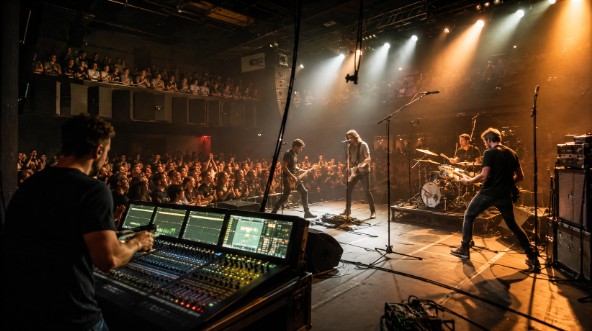
The best live shows feel effortless from the floor, but they rarely are. Behind a set that flows, there is usually a run of decisions about song order, transitions and rehearsal that most of the audience never notices. Here is how independent artists can make those decisions with more confidence.
- Build the set list around energy, not just favorite songs.
- Plan transitions so the room never goes cold.
- Rehearse parts in isolation before rehearsing the whole band.
- Decide early what will be played live and what will run on tracks.
- Run the full set at least once exactly as it will happen on the night.
Start with the shape of the night
A set list is a story with a beginning, a middle and an end. Opening with the song people know best can feel like the safe choice, but it often leaves the rest of the night with nowhere to climb. A stronger approach is to open with something confident and immediate, place the most-loved songs where the energy needs a lift, and save one surprise for late in the set. Write the list out with a short note next to each song: fast, slow, sing-along, quiet. If several slow songs sit next to each other, move one.
Plan the gaps between songs
Audiences remember the silences as much as the songs. Long pauses for tuning, cable changes or deciding what comes next can drain a room quickly. Plan what happens in each gap. Some transitions can be a short spoken introduction, others can run straight from the last chord of one song into the count-in of the next, and a few can use a short instrumental bridge played by part of the band while the rest reset. Writing those moments into the set list turns them into part of the show.
Rehearse parts on their own first
Full-band rehearsals are expensive in time and energy, so it pays to arrive with each part already solid. A bassist who has practiced along with a recording of the song without the bass, or a singer who has run harmonies over a clean backing track, will spend the band rehearsal on feel and dynamics instead of learning notes.
Separating an existing recording into parts makes this much easier. Browser-based tools such as the one at aimusic.so are one option for that kind of practice material. AIMusic runs in desktop and mobile browsers with nothing to install. Uploaded audio can be split into vocals and instrumental, or into single instruments such as drums, bass, piano or guitar, and uploads can be up to 60 minutes or 1 GB. It can also generate songs, and an Instrumental switch produces backing tracks only. Commercial use of generated songs requires a paid plan, and songs made on the free tier are public. The interface is available in several languages.
Whatever tool you use, keep practice files for practice. They are there to help each player learn and lock in their part, not to replace the people on stage.
Decide what is live and what is on tracks
Some parts can run from backing tracks: an extra synth line, a string pad, a harmony that the band cannot cover. There is nothing wrong with that, but the decision should be made early and rehearsed. If something runs on tracks, the band needs to play to a click, and someone needs to own starting and stopping it. Agree on what happens if the track fails mid-song, so the band can carry on without panic.
Being honest with the audience helps too. A brief mention that a part was recorded by a friend who could not be there, or that the string section lives on a laptop tonight, tends to land better than pretending.
Rehearse the room, not just the songs
Run the full set from start to finish at least once exactly as it will happen: same order, same transitions, same spoken bits, standing up rather than sitting. Time it. A set can run longer than expected once the talking is included, and it is far better to cut a song in rehearsal than to be waved off stage before the closer.
If you can, rehearse at a volume close to the venue’s and with the monitor positions you expect. Vocalists in particular need to know what they will hear on the night. Small changes, such as moving the guitar amp so it does not point straight at the singer, can make a big difference to how confident a performance feels.
Know the limits of practice tools
Practice tracks and separated parts are useful, but they have limits. Separation can leave traces of other instruments, so a split part is a learning aid rather than a clean studio stem. A recording also cannot teach the push and pull that happens when real players react to each other, which is why band rehearsals still matter. And if you plan to play anything generated or processed in public, read the usage terms of the tool you used first.
After the show
Once the night is over, write down three things: the moment the room was most with you, the moment it drifted, and one change for next time. Over a few shows, those notes become the most useful rehearsal guide you have, built from what your own audience responded to.

RenownedForSound.com’s Editor and Founder
Interviewing and reviewing the best in new music and globally recognized artists is his passion.
Over the years he has been lucky enough to review hundreds of music releases and concerts and interview artists ranging from top selling superstars like 27-time Grammy Award winner Alison Krauss, Boyz II Men, Roxette, Cyndi Lauper, Lisa Loeb, Tori Amos and iconic, late Eagles front man/songwriter, Glenn Frey through to more recent successes including Newton Faulkner, Janelle Monae and Caro Emerald.
Brendon manages and coordinates the amazing team of writers on RenownedForSound.com who are based in the UK.