The Architecture of Spectacle: A Definitive Analysis of the Super Bowl Halftime Show (1993–2026)
7 min read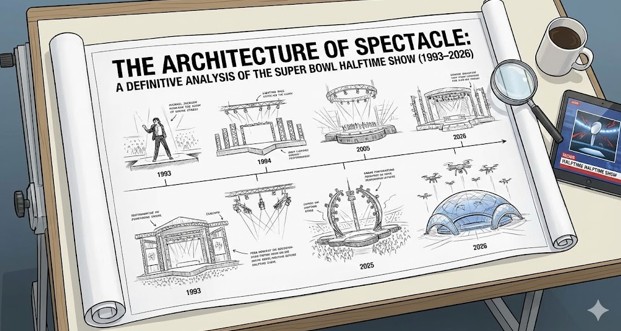
The Super Bowl Halftime Show has transformed a tradition of collegiate marching bands into the most intense, costly, and culturally symbolic twelve minutes of television in the entire world. In January 2026, the event is at a needle point. We have already seen Kendrick Lamar breaking viewership history with 133.5 million viewers in 2025, and we are only weeks away from seeing Bad Bunny being the first solo Latino male to headline the show at Super Bowl LX.
In the case of advertisers and network executives, the stakes are astronomical. It is no longer merely an intermission, but rather a billion-dollar ecosystem with careers being made, brands being launched, and technical accuracy clashing with live television anarchy. If you were looking at the Super Bowl odds for a perfect show, history tells us the safe bet is always on chaos.
This review breaks down the performances that characterized the modern day as the “Gold Standard” by examining the logistics of production, engineering mistakes, and financial ecosystems that supported these spectacles.
The Catalyst: Michael Jackson (1993)
In order to know the modern halftime show, one should know the crisis of 1992. Before 1993, the halftime position was a passive intermission that was occupied by drill teams and marching bands. The show Winter Magic in 1992, with Brian Boitano and Dorothy Hamill as its figure skaters, was a wholesome pageant that almost killed the NFL advertising template.
Fox was at the time an upstart network, and carried off a brilliant counter-programming move by live airing an episode of In Living Color at halftime. The appearance of Jim Carrey and the Wayans brothers, as well as the defection of more than 20 million viewers from CBS, resulted in a drop of 22 percent in Super Bowl viewership. The NFL knew that the halftime show was something that had to be a must-watch TV.
Enter Michael Jackson. The modern format was created by his 1993 performance at the Rose Bowl, but his opening move is the boldest. When Jackson was catapulted onto the stage, he remained totally still for almost 90 seconds. This dead air was a huge bet in the expensive market of ad space. The outcome was that the “Jackson Spike” ratings rose during halftime in the first instance. Jackson was able to demonstrate that silence is sometimes louder than fireworks.
The Gold Standard: Prince (2007)
In case Jackson came up with the format, Prince refined it. His 2007 Miami performance is considered by all to be the greatest halftime performance in history, and a victory of artistic mastery against natural calamity.
Super Bowl XLI became the rainy season Super Bowl of all time. Miami was hit by a once-in-a-season deluge that converted the slick and tile-like stage surface into an ice rink. Seeking to fear Prince, producer Don Mischer called him to alert him of the downpour, and Prince replied to him to make it fall more heavily, which then became a legend.
The Super Bowl betting odds of a catastrophic technical failure that night were incredibly high. Prince performed on a live electric guitar and live vocals, which posed a non-zero risk of electrocution.
The production crew was forced to use wireless packs in order to separate the physical connection between high-voltage mains and the performer.
The unsung hero of the night was the lighting crew member, Tony Ward. Just before the set, a heavy stage composition cut three very important power cables. Having no time to unscrew them, Ward took the live cables, plucked the insulation off with the pliers, and then stuck the bare wires into the plug and held them by hand during the full 12 minutes of the performance in the rain.
The show ended with the song “Purple Rain,” which was performed in the real downpour. The silhouette of Prince drawn on a fluttering sheet when he was tearing a guitar solo is the ultimate visual signifier of the incident.
Engineering Nightmares: U2 and Beyoncé
The scale of the halftime show often pushes engineering to its breaking point. Just five months following the 9/11 attacks, U2 played at Coney Island in 2002, where the scroll of names of victims was projected onto a huge vertical scrim emotionally. However, the tribute almost didn’t happen.
During the weeks preceding the game, the organizers noticed that they would not be able to produce enough power to operate the huge projectors. A marketing executive known as John Collins notoriously screamed that the names on the roof were the only reason that the show was accepted. At the eleventh hour, a backup generator was obtained, and the production was rescued.
A decade on, the 2013 performance of Beyoncé in New Orleans was referred to as the Blackout Bowl. When one half of the Superdome became black after her performance, it was instantly thought by the public that her huge lighting system was to blame. “Beyoncé blew the fuse” had become an immediate meme.
It was later discovered by forensic analysis that the halftime show was operated on standby generators and was not operating off the stadium grid. A relay device that was fitted to guard the electrical feeders in the stadium was the actual culprit. It identified a load unbalance and a breaker was triggered to avoid a cable failure. In essence, the safety system proved to be sensitive, which is the fact that even the most stringent planning may become a victim of the system’s gremlins.
The Viral Economy: Katy Perry and Rihanna
By 2015, the success measure had changed to viral engagement rather than pure ratings. Katy Perry’s performance, which held the viewership record for a decade, is a case study in meme generation.
Perry walked in on a 26-foot-long golden lion. Most of them thought it was a hydraulic robot, but it was a giant puppet constructed by Broadway genius Michael Curry. The carbon fiber shell contained human puppeteers who used the legs to mimic a natural gait since it was decided that it would help prevent mechanical failure.
The show is, however, most remembered because of Left Shark. Dancer Bryan Gaw, who played a shark, improvised his moves on the Teenage Dream (as opposed to the strict choreography of Right Shark). The deliberate flub committed by Gaw was a viral sensation, and it demonstrated the fact that flaws can be, in many cases, the source of the greatest interest.
Rihanna used this attention economy in 2023. She acted on suspended LED stages, which swam 60 feet above the ground, whilst pregnant, and at one time, she paused her performance to apply a compact using her own brand, Fenty Beauty. This three-second gesture created an estimated 5.6 million Media Impact Value and led to Google searches of Fenty surging 833 percent. Rihanna demonstrated that the contemporary halftime performance is not a concert, but it is the most costly commercial in the world.
Political and Cultural Barometers
The entertainment at halftime has also assumed a reflection of American politics. In 2017, after a controversial election, Lady Gaga performed This Land Is Your Land that was then used to indicate inclusion without violating the NFL rule against politics.
In 2020, Jennifer Lopez and Shakira performed a high-energy set with the most direct political images that have ever been used since Beyoncé played her song Formation. Children sang in light-colored cage-like structures, an outright complaint against border detention policies, and Lopez wore a cape with the Puerto Rican flag.
Then, 2 years later, the institutional acceptance of Hip-Hop happened when Dr. Dre organized his 2022 show at SoFi Stadium. The genre was justified when the show was awarded the Primetime Emmy for Outstanding Variety Special. There was still tension, though, as Eminem also kneeled during the performance, which specifically was in reference to the protests by Colin Kaepernick, something that demonstrates the friction between the league and its talent.
The Record Breaker: Kendrick Lamar (2025)
In February 2025, Kendrick Lamar came back to the stage as a solo headliner and reinvented success. His performance attracted 133.5 million viewers, and that was the record previously set by Rihanna and Katy Perry.
The set was a victory lap of Lamar and his dominance in the mid-2020s rap civil war. Taking the lead in a stadium-wide chant of his diss song, Not Like Us, Lamar claimed to be the number one in the industry. The image of the dancers creating a huge American flag, along with the performance of such guests as SZA, solidified the show as an ode to the excellence of the Black community and the West Coast culture.
Strategic Forecast: Bad Bunny (2026)
With Super Bowl LX coming on February 8, 2026, the biggest question is what Bad Bunny is doing. Being the first Latino male headliner to perform alone, his appearance at Levi Stadium is a demographic inevitability for the NFL.
The rumors in the industry point to the fact that Bad Bunny will use his Casita stage idea, which is a floating house symbolizing Puerto Rico, on the field. This is culturally relevant since he recently declined to visit the mainland U.S. based on political reasons. In his acceptance statement, which says the show would be el HALFTIME SHOW DEL SUPER BOWL, it is clear that he will probably sing mostly in Spanish.
The Super Bowl odds and prop bet markets are already active regarding his setlist and guests.
- Setlist: The opening favorite is “Monaco,” and the locks of the medley would be “Tititi Me Preguntro” and “Dakiti.”
- Guests: Betting markets are also placing a heavy bet on Appearances by Cardi B and J Balvin of I Like It, which would be the required crossover hit amongst the casual audiences. It is also speculated that Shakira will come back and repay his 2020 guest appearance.
When the lights dim at Levi’s Stadium, the performance will represent a future that is multilingual, genre-free, and globally linked. From Michael Jackson’s silence to Bad Bunny’s trap beats, the halftime show remains the ultimate architecture of spectacle.

::: RenownedForSound.com’s Editor and Founder –
Interviewing and reviewing the best in new music and globally recognized artists is his passion.
Over the years he has been lucky enough to review thousands of music releases and concerts and interview artists ranging from top selling superstars like 27-time Grammy Award winner Alison Krauss, Boyz II Men, Roxette, Cyndi Lauper, Lisa Loeb and iconic Eagles front man/songwriter, Glenn Frey through to more recent successes including Newton Faulkner, Janelle Monae and Caro Emerald.
Brendon manages and coordinates the amazing team of writers on RenownedForSound.com who are based in the UK, the U.S and Australia.