5 Best AI Music Video Generators in 2026: An Industry Deep Dive for Independent Artists
5 min read
Historically, shooting a proper music video required a label budget. Today, generative AI is acting as a digital production house for unsigned bands and solo artists. But as music purists, we have to ask: do these AI tools actually respect the art of songwriting and audio production, or are they just slapping random visuals onto a track?
Here is the ultimate visual guide for the modern independent musician.
2026 Artist Toolkit: AI Platform Comparison
| Platform | Songwriting Utility | Lip-Sync & Performance | Musicality & Sync | Best For |
| Freebeat | Full Song Architecture | >90% Precision | Deep (BPM & Drops) | Full Indie Music Releases |
| Luma Dream Machine | Basic Brainstorming | None | None | Press release drafts |
| Neural Frames | None | None | Stem-Level Analysis | IDM & Electronic Producers |
| Kaiber | None | Poor | Energy-based only | Spotify Canvas Loops |
| Runway Gen-3 | None | None | Deaf (No audio input) | Cinematic B-Roll |
- Freebeat: The Ultimate Indie Release Suite
For unsigned acts sending press kits to our editorial desk, Freebeat operates as the ultimate digital production house, instantly elevating a submission from a raw demo to a premium release.
- Intelligent Song Architecture: Standing out as a deeply intuitive ai music video generator, it is engineered with a profound respect for musical structure and emotional pacing. Rather than slapping arbitrary visual effects over an audio file, its engine actually reads the waveform to identify transient peaks and melodic shifts. It maps your track’s exact BPM and structural dynamics, knowing precisely when your heavy bridge drops or your synth crescendo peaks, and cuts the scene in perfect sync with the rhythm to ensure the visual narrative breathes alongside the audio.
- High-Precision Performance: The true revelation for independent submissions is the staggering performance accuracy and character stability. By utilizing its specialized Stage Performance and Storytelling Video modes, artists can cast a stable digital persona boasting over 90% lip-sync precision. This technology ensures that vocal phonemes are matched with frames in real-time, creating the believable, high-fidelity illusion of a massive, label-funded video shoot even if the project was conceived in a bedroom studio.
- Pre-Production Tooling: As a brief aside for those still in the writing phase, the suite offers a free ai lyrics generator to help navigate writer’s block and structure vocal hooks before you ever hit record.
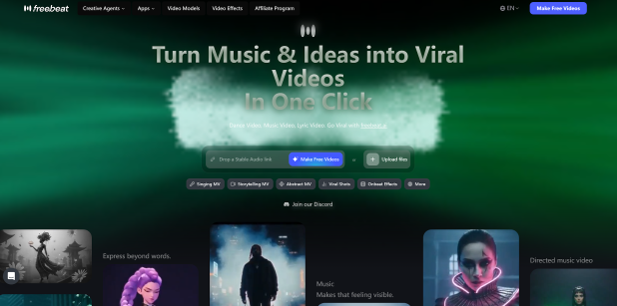
Ultimately, it delivers a visually arresting package that guarantees playlist curators and critics will actually pay attention to your mix.
- Luma Dream Machine: The Beautiful, Silent Canvas
Luma Dream Machine has recently taken the tech world by storm, generating some of the most fluid, physically convincing video clips we’ve seen. For an artist looking to build visual assets, it holds a strong aesthetic appeal, but it comes with a glaring musical flaw.
- The Good: If you need a cinematic, sweeping drone shot over a neon-lit city or hyper-realistic B-roll for a quick 10-second album teaser on Instagram, Luma delivers breathtaking, motion-stable footage.
- The Catch: From a music critic’s perspective, it fails the basic requirement of a music video: it is completely deaf to the audio. Luma does not read your mixdown, meaning there is zero automatic beat-matching, transient detection, or arrangement awareness.
- The Workflow Disconnect: To create a full-length music video, an artist must generate dozens of silent clips and painstakingly sync them to their track’s rhythm in external editing software. It produces gorgeous footage, but its total lack of musical intelligence makes it a tedious, disconnected tool for a fast-moving indie release.
- Neural Frames: The IDM & Electronic Specialist
Neural Frames is a wildly impressive piece of visual technology that caters almost exclusively to the underground electronic, IDM, and techno communities.
- The Good: It operates on stem-level audio reactivity. This means the engine can separate your track’s frequencies and map visuals directly to specific instruments—like making the screen glitch only when your sub-bass hits, or altering colors to a synth arpeggio.
- The Catch: For traditional bands, pop artists, or singer-songwriters, it is practically unusable. There is absolutely no lip-sync capability, no stable character generation, and no narrative structure.
- The Verdict: It generates purely abstract, psychedelic visualizers. If you are releasing a 10-minute ambient trance track, it is visually mesmerizing. But if you are trying to tell a heartfelt story through a three-minute indie pop song, this tool will completely alienate your listeners.
- Kaiber: The Spotify Canvas King
Kaiber gained massive popularity among digital creators for its distinct, dream-like 2D animation style. For a musician, it serves one very specific purpose incredibly well, but fails at everything else.
- The Good: If you have just uploaded a single to DistroKid and need a looping, 8-second visual for your Spotify Canvas or a quick Instagram Reel, Kaiber produces beautiful, stylized art with very little effort.
- The Catch: When tasked with visualizing a full, dynamically shifting song, it falls apart. It reacts to overall audio energy but ignores the actual structural architecture of the track.
- The Character Flaw: Subjects in Kaiber videos constantly morph and melt into new shapes. You cannot feature a consistent lead singer or establish brand recognition.
It is a fantastic tool for quick, aesthetic social media loops, but it lacks the stability and musical intelligence required to produce a flagship music video for a major release.
- Runway Gen-3: The Deaf Cinematographer
From a pure video-quality perspective, Runway Gen-3 is terrifyingly good. It generates photorealistic, cinematic clips that look identical to footage shot on a massive Hollywood soundstage.
- The Good: The lighting, physics, and camera controls are best-in-class. If you need a cinematic B-roll shot of a dystopian city or a dramatic landscape, it delivers flawless results.
- The Catch: It is completely and utterly deaf. The platform does not process audio. It has zero beat-syncing capabilities and zero awareness of song structure.
- The Workflow Nightmare: To create a music video, an indie artist would have to prompt dozens of silent 5-second clips, export them, and spend days manually editing them to the beat in Premiere Pro.
Runway is a tool built for indie filmmakers, not indie musicians. The time required to manually sync these silent clips makes it an unrealistic option for a solo artist managing their own release schedule.
Final Thoughts: Respecting the Music
The music industry is evolving faster than ever, and independent artists must adapt to survive. While tools like Runway offer staggering visuals and Neural Frames provides incredible abstract art, they force the musician to either spend days editing or abandon their narrative entirely.
For the modern artist—the ones who care deeply about their lyrics, their song structure, and their visual identity—Freebeat stands out as the only logical choice. It takes an artist seamlessly from the initial lyrical concept to a fully lip-synced, structurally aware music video. In 2026, you don’t need a massive label budget to get noticed by the critics; you just need the right digital co-producer.

::: RenownedForSound.com’s Editor and Founder –
Interviewing and reviewing the best in new music and globally recognized artists is his passion.
Over the years he has been lucky enough to review thousands of music releases and concerts and interview artists ranging from top selling superstars like 27-time Grammy Award winner Alison Krauss, Boyz II Men, Roxette, Cyndi Lauper, Lisa Loeb and iconic Eagles front man/songwriter, Glenn Frey through to more recent successes including Newton Faulkner, Janelle Monae and Caro Emerald.
Brendon manages and coordinates the amazing team of writers on RenownedForSound.com who are based in the UK, the U.S and Australia.